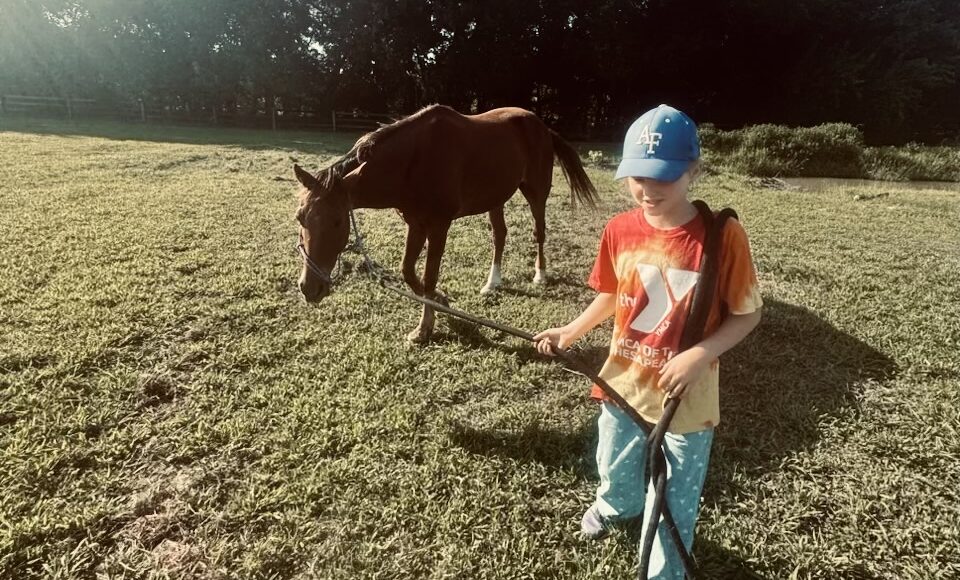
A Familiar Scene at the Ranch
In our work with kids and horses, we play a lot of games together. One of them involves leading a horse over a series of obstacles—simple things like poles on the ground, a tarp, or a narrow space between barrels. Nothing dangerous. Just unfamiliar.
When a horse encounters something new, it often stops.
That’s exactly what happened the day Trina was working with our horse Red to cross a tarp on the ground.
Red is curious and kind, but like most horses, he’s cautious. When he reached the obstacle, he stopped, stood still, and sniffed the tarp. He wasn’t spooked. He wasn’t refusing. He was just thinking.
Trina didn’t see it that way.
She pulled on the lead rope.
Harder.
And then harder still.
It was one of those scenes that makes you smile and wince at the same time—a young girl, all seventy-something pounds of her, leaning back with everything she had, tugging on a rope attached to a thousand-pound horse who wasn’t going anywhere.
Absolutely nothing happened.
When Pulling Feels Like Leadership
Red planted his feet. Trina got frustrated. The rope grew tight. The harder she pulled, the more Red leaned back against her.
From the outside, it was obvious. Force wasn’t going to work. But in the moment, pulling felt like the right response. “If I just try harder, he’ll move.“
We see this almost every time.
No one teaches kids to do this. We don’t tell them, “When the horse won’t move, yank harder.” They just do it. It’s instinctive. When something won’t go where they want it to go, they apply pressure.
Learning to Pause Instead of Pull
Eventually, Trina stopped pulling.
I wasn’t sure if she was quitting, but I asked her to not to give up—but to pause for a few seconds and just stand next to Red. To take a breath. To loosen the rope just a little. To pay attention. To notice Red’s ears, his breathing, the way his body was angled toward the obstacle.
At first, it felt like doing nothing.
But slowly, something changed.
As Trina relaxed, Red did too. I asked her to back him up just a little before trying again.
Then when she began to step forward calmly instead of pulling, Red followed. Not because he was forced—but because he trusted her enough to try.
The obstacle hadn’t changed.
Trina had.
What Horses Make Impossible to Ignore
Horses are remarkable teachers because they don’t hide what’s happening inside. They don’t mask uncertainty. They don’t comply politely while resisting internally. If they don’t trust you, you know it immediately.
I can think of plenty of moments in my own years of fatherhood when I raised my voice and my expectations—rather than taking the slower work of building my kids’ trust in me.
Kids often respond the same way—just with words, behavior, or attitude instead of hooves and muscle.
When kids feel pressure without clarity, they resist. Sometimes loudly. Sometimes quietly. Sometimes in ways that look like defiance, withdrawal, or trouble. Adults often respond by pulling harder—more rules, more consequences, more control.
But force rarely answers the real question kids are asking.
Is this safe?
Can I trust you?
Are you with me, or just trying to move me?
Pressure Is Not the Same as Leadership
What horses make clear is something we often miss with people: pressure and leadership are not the same thing.
Pressure demands movement.
Leadership invites trust.
Force may create short-term compliance, but it doesn’t produce cooperation. Cooperation grows when someone feels safe enough to follow.
That’s why calm leadership outlasts control.
With horses, leadership looks like clarity, consistency, and emotional steadiness. With kids, it looks remarkably similar. Clear expectations. Firm boundaries. A calm, stable adult. Someone willing to slow down instead of escalate.
When Trina stopped trying to overpower Red and started leading him, everything changed. Not instantly. Not dramatically. But enough.
And that’s usually how it works.
A Lesson That Carries Beyond the Ranch
Horses remind us that leadership begins with who we are, not what we demand.
And that lesson carries into every relationship.
If these reflections resonate with you, you’re welcome to follow along as we continue sharing what we’re learning while walking with kids and families, one step at a time.