Building Confidence in Kids Through the Words We Speak and the Faith We Model
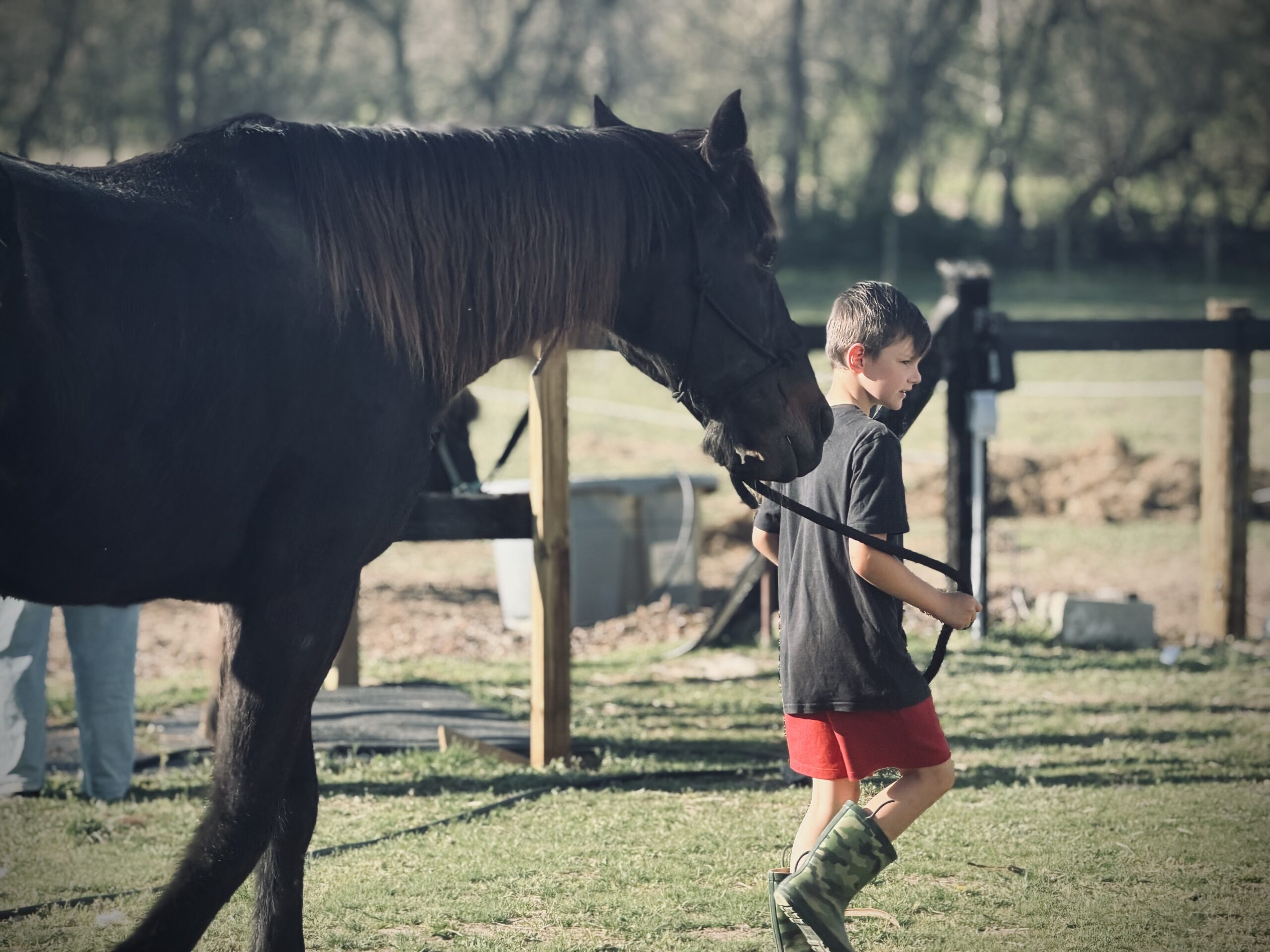
The other day, one of our mentors was working with a child on leading their horse through some obstacles.
For most of the course, things were going really well. The horse was responsive, attentive, and willing. They moved through turns, around barrels, and over small challenges with very little resistance.
And then they came to the wooden bridge.
It’s a simple obstacle—just a small raised platform—but in that moment, everything changed.
No matter what they tried, they couldn’t get Shiloh, our oldest rescued Standardbred, to step onto it.
This wasn’t a new kind of challenge for him. He’s been around long enough to have seen plenty of unusual things. But not here. Not with us. And in that moment, something inside him said, “I’m not sure I can trust this.”
You could see it in the way he stopped and stared at the bridge.
He wasn’t being stubborn or difficult. He just wasn’t ready to move forward.
And as I watched that moment unfold, I was reminded of something we see again and again—not just with horses, but with kids.
When pressure rises, what’s underneath gets revealed.
WHEN CONFIDENCE BREAKS DOWN UNDER PRESSURE
Most of the time, kids can do more than we think they can.
They learn the steps and understand what’s being asked. They even show confidence—until something shifts. A challenge feels unfamiliar. The pressure increases. The outcome becomes uncertain.
And suddenly, what seemed easy doesn’t feel easy anymore.
If we’re focused on building confidence in kids, it’s important to understand that these moments are not interruptions to growth—they are the very place where growth happens.
Because pressure doesn’t create something new.
It reveals what’s already there.
Just like Shiloh at the bridge, a child’s response in those moments often has less to do with ability and more to do with trust—what they believe about themselves, what they believe about the situation, and ultimately, what they believe will happen if they take the next step.
THE POWER OF YOUR VOICE IN THOSE MOMENTS
This is where a parent’s voice becomes incredibly important.
When a child hesitates, struggles, or begins to pull back, our instinct is often to correct or to fix. We want to help them get through the moment as quickly as possible.
But what matters most in those moments is not just what we tell them to do.
It’s what we are helping them believe.
Over time, our words begin to form an internal voice that our kids carry with them. In moments of pressure, they don’t just hear instructions—they hear identity.
They hear things like:
“I can’t do this,”
“I always mess this up,”
or, “I’m not good at this.”
Or, if something different has been planted over time:
“I’ve done hard things before,”
“I can stay with this,”
“I don’t have to get it perfect to keep going.”
That’s why building confidence in kids is not just about helping them succeed.
It’s about shaping what they believe when success doesn’t come easily.
WHY OUR WORDS ARE NOT ENOUGH ON THEIR OWN
As important as our voice is, there is an honest tension we have to acknowledge.
We are not always steady.
Sometimes we are tired – frustrated. Sometimes we say the wrong thing, or we say the right thing at the wrong time. If a child’s confidence depends entirely on us getting it right, it will eventually be shaken.
That doesn’t mean our words don’t matter.
It means they are meant to point to something deeper.
Because what our kids ultimately need is not just encouragement from us.
They need a foundation that will hold when both they—and we—are under pressure.
THE KIND OF FAITH THAT HOLDS
This is where faith becomes more than something we talk about.
It becomes something we model.
Before Jesus began His ministry—before He performed a miracle or taught a crowd—the Father spoke these words over Him: “This is my Son, whom I love; with him I am well pleased.”
That identity came before performance.
And it carried Him through everything that followed—temptation, rejection, suffering, and ultimately the cross.
Jesus did not establish His identity under pressure.
He lived from it.
And that same kind of identity is what gives real confidence to us—and to our kids.
If we want to be intentional about building confidence in kids, we have to give them something that doesn’t change when life gets hard.
Not an identity based on performance.
Not one based on approval.
But one rooted in the unchanging love of God.
HOW GOD USES ORDINARY MOMENTS TO BUILD CONFIDENCE
One of the things we’ve come to appreciate at the ranch is that the horses are not the point.
They are part of the process.
God uses these moments—leading a horse, facing an obstacle, working through frustration—as opportunities to shape something deeper in a child.
Times they feel unsure… and stay with it.
Or times they want to quit… and take one more step.
Moments where they realize they are not alone.
In many ways, these are small, everyday means through which God forms confidence, character, and faith.
And the same is true outside the ranch.
It happens in your home, in ordinary conversations, in moments that don’t seem significant at the time but are quietly shaping how your child sees themselves and the world around them.
WHAT THIS LOOKS LIKE FOR YOU AS A PARENT
So what does this mean for you?
It means that in those moments when your child is standing at their own version of the wooden bridge, your role is not simply to get them across it.
Your role is to help them learn what it means to trust—both what’s been placed in them and the One who is with them.
That may look like speaking steady, simple truths:
“I’m here with you. You can take the next step.”
“This doesn’t change who you are.”
“Let’s stay with it together.”
It also means allowing space for the struggle, rather than removing it too quickly.
Because confidence is not built by avoiding difficulty.
It is built by walking through it—with support, with truth, and with time.
WHAT REALLY BUILDS CONFIDENCE
Watching Shiloh at that bridge, it would have been easy to assume the problem was the obstacle.
But it wasn’t the bridge.
It was trust.
And in many ways, that’s what we’re building in our kids as well.
Not just the ability to perform.
Not just the ability to succeed.
But the kind of confidence that comes from knowing they are secure—even when they are unsure.
Because when a child knows they are not alone… when they know they are loved… when they know who they are and whose they are…
They begin to take steps they never would have taken before.
And that is what it looks like to be intentional about building confidence in kids—not just for the moment, but for a lifetime.
If You’d Like to Read More
If this idea resonates with you, it’s part of a larger conversation we’ve been having about what it really looks like to build strength, confidence, and resilience in our kids.
Each of these articles builds on the last, and together they form a simple but important pathway:
- We begin by learning to let go of control, recognizing that confidence isn’t formed when we manage everything for our kids.
- Then we explore how struggle is not something to avoid, but something to walk through—because growth happens there.
- From there, we see that identity is the foundation of confidence, shaping how a child responds when things don’t go as planned.
- And now, we’ve come to understand that faith is what ultimately holds under pressure, giving our kids something deeper than performance to stand on.
If you’d like to go back and read from the beginning or revisit a specific part of the journey, here are the previous articles in this series:
- Confidence Isn’t Built Through Control
- Failure is a Great Teacher
- Building Confidence in Kids Starts with Identity
My hope is that these aren’t just ideas to think about, but truths you can begin to live out in the everyday moments with your kids—because those are the moments that shape them most.