
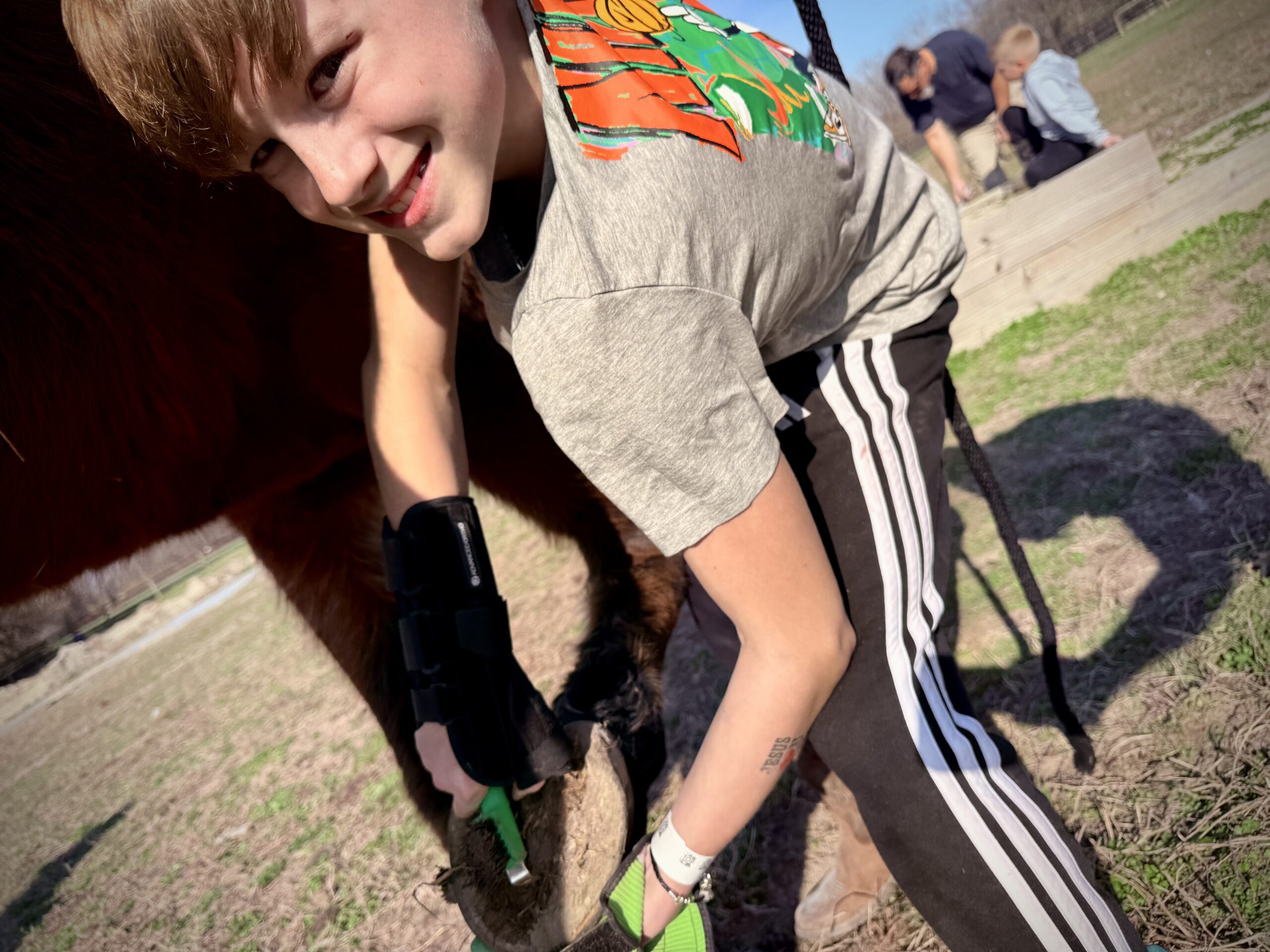
Why Building Confidence in Kids Starts with Who They Believe They Are
WHEN SOMETHING SHIFTS
If you spend any time around horses, you start to notice something pretty quickly—things don’t always go according to plan.
And honestly, that’s not a bad thing.
At the ranch, some of the most important moments don’t happen when everything goes right. They happen when something shifts—when a horse hesitates, a child gets frustrated, or a simple task suddenly feels harder than it did just a moment before.
Those are the moments when growth is actually within reach.
They are also the moments when most of us feel the urge to step in and fix things.
If you’re focused on building confidence in kids, that instinct is something we have to learn to manage. Because the goal isn’t to eliminate struggle—it’s to help our kids learn how to move through it.
And more often than we realize, what determines whether they move through it well has very little to do with skill—and everything to do with identity.
WHEN CONFIDENCE FADES
Let’s call her Lauren.
She had been through our program before, and the last time she was here, everything seemed to come naturally. She connected quickly, picked things up easily, and developed a real feel for working with horses. So when she returned the next season, she carried an expectation with her—whether she realized it or not—that she would step right back into that same rhythm.
On the first night, she chose Red, an energetic horse who tends to reflect the person leading him.
At first, everything looked familiar. She remembered what to do, and she started well. But it didn’t take long for something subtle to shift. It had been a long winter, and instead of simply engaging the moment, Lauren began trying to live up to who she had been the last time she was here.
You could see it in small ways. Her grip tightened slightly. Her movements became more cautious. She hesitated just enough to lose clarity.
Red noticed immediately.
Instead of following close, he began to drift; instead of responding to cues, he was focused on creating space. Lauren responded the way most of us do when things aren’t going as expected—she tried harder. She corrected more. She added a little urgency.
But the more she tried to control him, the less he responded.
After a moment, I asked her to stop. I had her place her hand on Red’s side and simply breathe for a minute—no pressure, no correction, just a chance to settle.
Then I encouraged her, “Stand up tall and walk like you know where you’re going.”
What happened next was subtle, but unmistakable.
Her posture changed. Her steps became more intentional. There was a steadiness in her that hadn’t been there before.
And almost immediately, Red responded.
What looked like a horsemanship issue wasn’t really about skill at all. It was about identity.
WHY BUILDING CONFIDENCE IN KIDS STARTS WITH IDENTITY
Over time, we’ve seen this pattern repeat itself in different ways.
Most kids don’t struggle because they lack ability. In fact, many of them are capable of far more than they realize. What they struggle with is what failure seems to say about them.
When something doesn’t go well, it’s easy for the moment to become personal.
Instead of thinking, “That didn’t work,” a child begins to think, “Maybe I’m not good at this,” or even, “Maybe something is wrong with me.”
I saw this long before the ranch, back when I was coaching high school sports. Some of the most talented athletes were also the most fragile when things went wrong. As long as they were succeeding, everything held together. But when they made a mistake, their confidence seemed to unravel quickly.
What became clear over time is that their struggle wasn’t really about performance.
It was about identity.
If we’re serious about building confidence in kids, we have to understand that confidence is not just about success. It grows out of a stable sense of who a child is—especially when things don’t go as planned.
A child who knows who they are can recover from a mistake.
A child who ties their identity to success will often be undone by it.
The difference often shows up in a quiet but powerful shift—from “I failed” to “I am a failure.”
WHAT THE HORSES ARE REALLY TEACHING KIDS ABOUT CONFIDENCE
Horses have a way of bringing this to the surface.
They don’t simply respond to instructions. Horses respond to the person giving the instructions. They pick up on tension, hesitation, and uncertainty in ways that are hard to miss.
When Lauren became unsure of herself, Red didn’t just ignore her cues—he reflected what was happening inside of her. And when she settled—when her posture and presence aligned—he responded to that change.
Nothing about the task itself had changed.
But something about her had.
That’s what makes these moments so important.
Because while it may look like a lesson in horsemanship, something deeper is taking place. A child is learning not just what to do, but who they are in the middle of doing it—especially when it isn’t going well.
And that is where real confidence begins to take shape.
HOW BUILDING CONFIDENCE IN KIDS PLAYS OUT AT HOME
You don’t need to be around horses to see this dynamic at work.
It shows up when your child is struggling with school, when a friendship becomes difficult, or when they make a mistake and have to face the consequences. In those moments, our instinct is often to focus on behavior—what needs to be corrected, improved, or avoided next time.
But if our goal is building confidence in kids, we have to learn to look a little deeper.
We have to begin asking not only, “What needs to change?” but also, “What is this moment shaping in how my child sees themselves?”
Because the way we respond will help answer that question.
If every mistake is met with frustration, a child may begin to believe they are the problem.
If every difficulty is quickly removed, they may begin to believe they are not capable of handling hard things.
But if we remain steady—present without taking over—we create space for something better to grow. We give them the opportunity to stay engaged, to try again, and to discover that they are able to move through difficulty.
BUILDING CONFIDENCE IN KIDS THROUGH IDENTITY
This doesn’t mean ignoring behavior or lowering expectations.
It means learning to address behavior while protecting identity.
That often begins with the way we speak in those moments. A simple shift in language can make a significant difference. Instead of reinforcing failure, we can remind them of what is still true.
We might say, “That didn’t go the way you wanted, but you’re still learning,” or “This is something you can figure out—stay with it.”
At the same time, we resist the urge to step in too quickly. We stay close, we guide when needed, but we allow them to remain engaged in the process.
Over time, something begins to take root.
Our voice becomes part of their internal voice. Our steadiness becomes something they begin to carry within themselves.
And that is how confidence grows—not from perfect outcomes, but from repeated experiences of staying present and moving forward.
SCRIPTURE SHOWS US A DEEPER FOUNDATION
This principle doesn’t just come from observation. It is grounded in something deeper.
Before Jesus began His public ministry—before any miracles, before any teaching—the Father spoke over Him at His baptism: “This is my Son, whom I love; with him I am well pleased.”
That identity was not earned through performance. It was given before any visible success.
And it sustained Him through everything that followed—temptation, rejection, misunderstanding, and suffering.
Jesus’ resilience flowed from His identity.
And the same is true for us.
If we want to be intentional about building confidence in kids, we have to give them something that failure cannot take away. Not an identity built on performance or approval, but one rooted in love—and ultimately, in who they are in Christ.
Because when a child knows they are loved, even in moments of struggle, failure begins to lose its power to define them.
THE KIND OF STRENGTH THAT LASTS
At the end of the day, we are not raising kids who will always get it right.
We are raising kids who know who they are when they don’t.
And when identity is secure, confidence becomes something deeper than success.
It becomes steady.
It becomes resilient.
And that is what it looks like to focus on building confidence in kids.
If this idea of building confidence in kids through identity resonates with you, here are a few other articles that will help you take the next step:
- Confidence Isn’t Built Through Control
Why trying to manage every outcome can actually undermine the very confidence we’re hoping to build—and what to do instead. - What Horses Teach Us About Trust
How trust becomes the foundation for growth, and why kids need it before they’re ready for challenge. - Why Failure Isn’t the Enemy
A deeper look at how setbacks can actually become one of the most powerful tools in building resilience and confidence.