
The Urgency We Feel as Parents
All parents want the best for their kids.
When it comes to relationships at home, that usually means we want better behavior, better choices, and fewer blowups. We want peace. We want growth. We want things to work.
So when our kids are stuck in poor choices, repeated arguments, or ongoing struggles, most of us think the same thing:
This isn’t right—and I need to do something. Now.
Our instinct is often the same. We push for improvement. And to push someone, we have to get on their level.
So we raise our voice.
We raise our expectations.
We raise the pressure.
The problem is that pressure often increases the very behavior we’re trying to stop. What begins as a desire to help quickly turns into escalation. The harder we push, the more resistance we meet.
Quietly, underneath it all, another thought begins to surface:
What I’m doing isn’t working—and we need something to work now.
That urgency makes sense. It’s born out of care. But urgency can also blind us to what our kids actually need in the moment.
What We Really Mean by “Steady”
There’s a word that gets used often in conversations about kids and families—and it usually carries more confusion than clarity. That word is safety.
For many people, safety has come to mean permissive: low expectations, fewer consequences, and avoiding discomfort at all costs. But that kind of environment doesn’t actually help kids grow. It leaves them unsure, unanchored, and constantly guessing where the lines are.
That’s not what kids need.
What they need is something sturdier: steadiness.
Steadiness doesn’t remove boundaries; it holds them consistently. It doesn’t avoid conflict; it responds to it without losing footing. Steady leadership doesn’t change the rules based on mood, exhaustion, or frustration.
Steadiness answers a different question—not “Will I be protected from discomfort?” but “Who’s leading this, and can I trust them to stay grounded?”
When leadership is steady, kids don’t have to scan the room for emotional weather. They don’t have to guess which version of mom, dad, or grandparent they’re getting today. Even when they don’t like the outcome, they know what to expect.
That kind of predictability settles a child far more effectively than loosened boundaries ever could.
And it’s that steadiness—more than volume, pressure, or force—that creates the conditions for growth.
Why Growth Can’t Happen Without Steadiness
Here’s why this matters, in plain terms.
God designed us for relationship—first with Him, and then with one another. Emotions are part of that design. In healthy relationships, emotions help build connection.
But when situations feel unpredictable or unsettled, emotions often shift from connection to survival.
When that happens, our bodies go on alert. Thinking slows. Perspective narrows. Behavior becomes reactive rather than intentional.
That’s why, when your son snaps back, shuts down, or explodes over something small—or when your daughter withdraws, melts down, or suddenly won’t cooperate—it can feel confusing and frustrating.
Sometimes a child is being clearly disobedient or disrespectful, and that needs to be addressed. But more often than we realize, what we’re seeing isn’t rebellion—it’s self-protection.
Their brain isn’t asking, How can I make this harder?
It’s reacting because something feels overwhelming or unstable.
In those moments, forcing change rarely works. You can raise your voice. Restate the rule. Increase the consequence. But growth doesn’t happen when a child’s system is on high alert.
What both the child and the adult need in that moment is steadiness.
Steadiness slows the moment down. It allows emotions to settle. And when that happens, thinking comes back online. Connection can be restored. Learning can resume.
That’s why steadiness isn’t optional for growth—it’s foundational.
What We See at the Ranch
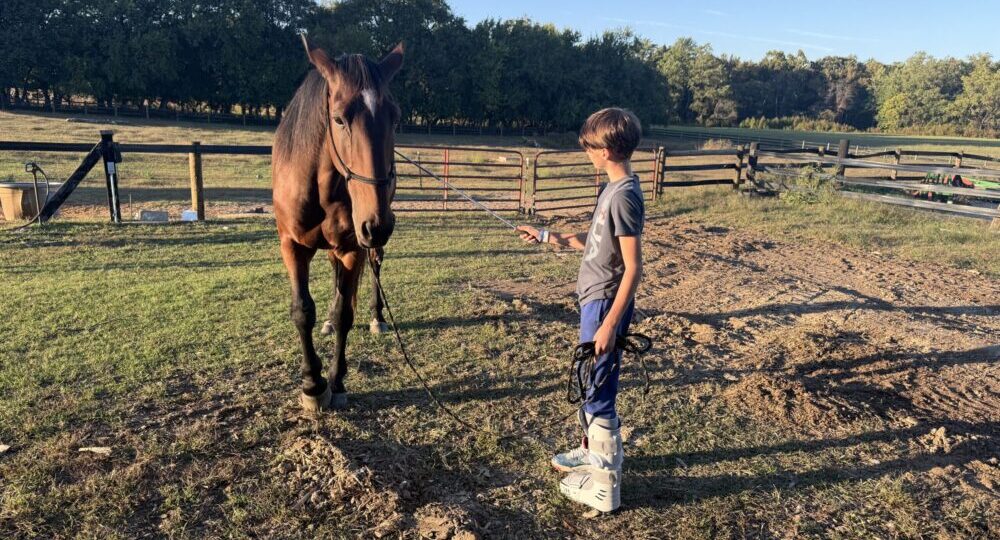
We see this lesson play out every day at the ranch.
When we introduce horses to something new, progress depends far less on the task itself than on the steadiness of the leadership guiding them through it.
Horses don’t hide when something isn’t right. Their head comes up. Their body tightens. Their breathing quickens. And in that state, force accomplishes very little—especially when the horse weighs twelve hundred pounds.
But when a horse begins to settle, the signs are just as clear. Their head lowers. Their breathing slows. They rest a hind leg. When that tension leaves their body, they’re ready to engage again.
A wise leader pays attention to this. Steadiness—clear, consistent, grounded leadership—comes before performance. Until a horse senses that steadiness, progress will always be limited.
Kids are no different.
What Steadiness Looks Like in Real Life
Steadiness doesn’t mean lowering expectations or avoiding hard moments. It means leadership that holds its ground.
In everyday family life, steadiness often looks quieter—and stronger—than we expect.
It looks like adults who remain predictable when emotions run high.
Boundaries that don’t shift based on the day we’ve had.
Correction that is firm without being reactive.
Steadiness shows up in presence. Staying engaged instead of checking out. Slowing the moment down instead of forcing a quick outcome. Being willing to say, “We’ll deal with this—but we don’t have to solve it right now.”
Just like with the horses, learning doesn’t happen in tense, unsettled moments. Progress comes when leadership is steady enough for a child to stay connected—even while being corrected.
That kind of leadership takes patience. It takes humility. And it often requires more work from the adult than the child.
But over time, it builds something lasting: cooperation rooted in trust, not compliance driven by pressure.
Where Faith Enters the Picture
This is where our faith matters.
Jesus was many things, and steady was certainly one of.
He was rooted in His identity as the Son of God, and because He knew who He was, He didn’t react when things went wrong. Circumstances changed. People changed. Opposition came and went. But Jesus remained grounded.
He connected before correcting.
He stayed present instead of pulling away.
He responded with wisdom rather than reaction.
His steadiness didn’t come from ignoring sin or lowering expectations. It came from being deeply anchored in His relationship with the Father. Because of that, He didn’t need to control people to bring about change. His presence created the conditions where transformation could happen.
Real change doesn’t come from pressure. It flows from leadership that is secure, grounded, and unwavering in love and truth.
A Different Measure of Growth
All of this reshapes how we measure growth.
Growth isn’t just better behavior.
It isn’t quicker compliance.
And it isn’t the absence of conflict.
Real growth shows up when a child stays engaged instead of shutting down. When they recover more quickly after hard moments. When they remain connected—even while being corrected.
That kind of growth takes time. It requires leadership that doesn’t panic when things get messy. It depends on adults who can stay steady long enough for kids to find their footing again.
We’re reminded of this lesson every day at the ranch. Horses don’t respond to force, and kids don’t grow under pressure. Growth comes when leadership is steady—when someone is willing to stay grounded, patient, and present long enough for trust to take root.
That kind of leadership isn’t flashy.
But it lasts.
And it carries far beyond the pasture, into every relationship that matters.
If these reflections are helpful, you might enjoy one of these as well:
you’re welcome to follow along or explore more stories and lessons from the ranch as we walk with kids and families together.